
Functional use cases and test scenarios for automated vehicles and commercial vehicles at unregulated intersections
To test functional use cases of autonomous vehicles and commercial vehicles, a controlled intersection with 4 junction arms and an uncontrolled intersection with 3 junction arms is implemented on the test track in St. Valentin.
For the crossing area with controlled C-ITS traffic lights, 18 functional test cases are provisionally planned on the test track in St. Valentin. These result in over 195 concrete traffic scenarios due to different speeds and obstacles. Communication V2I is also to be tested in different variants.
Functional use case 1: intersection scenario without traffic light control
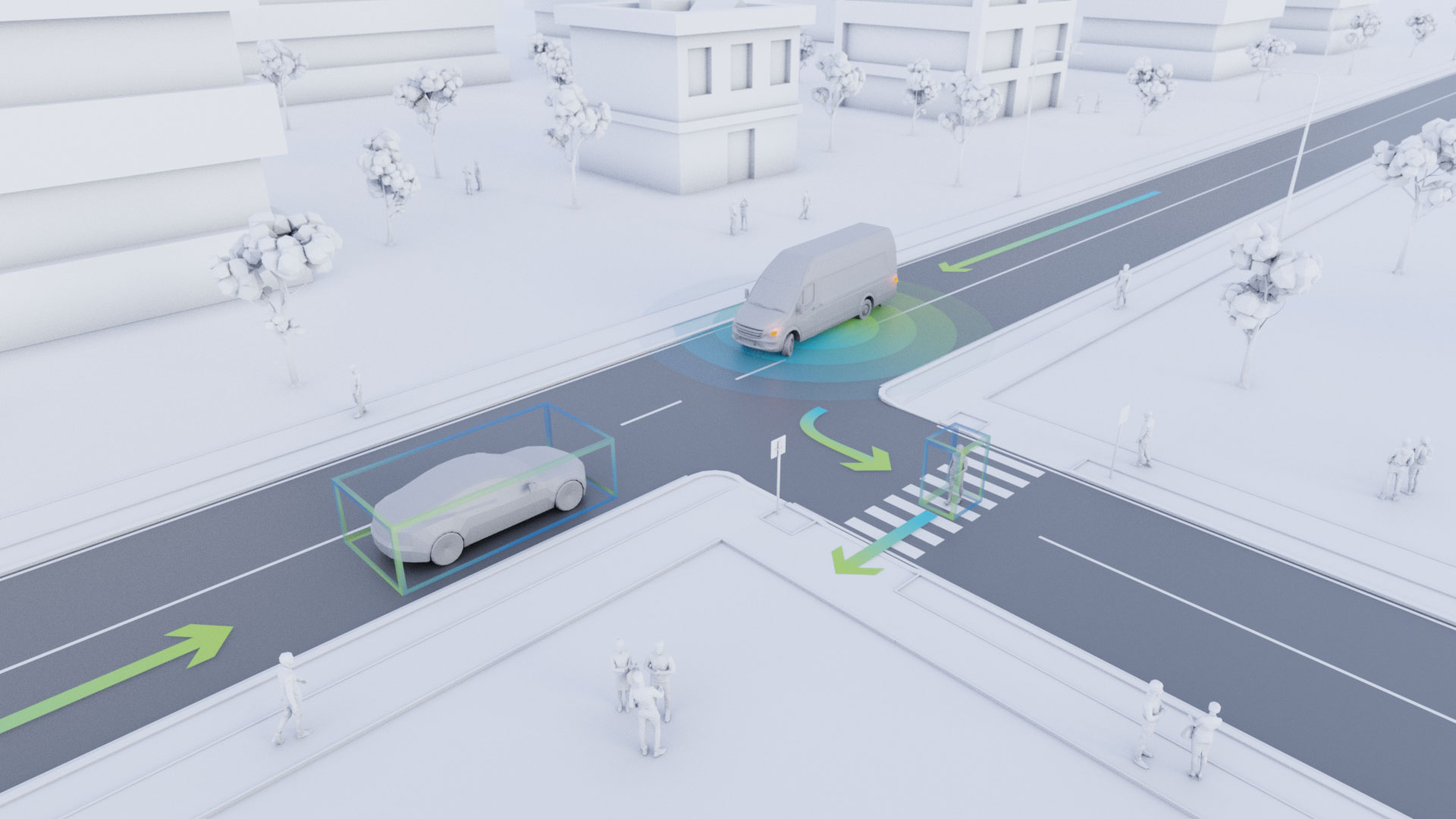
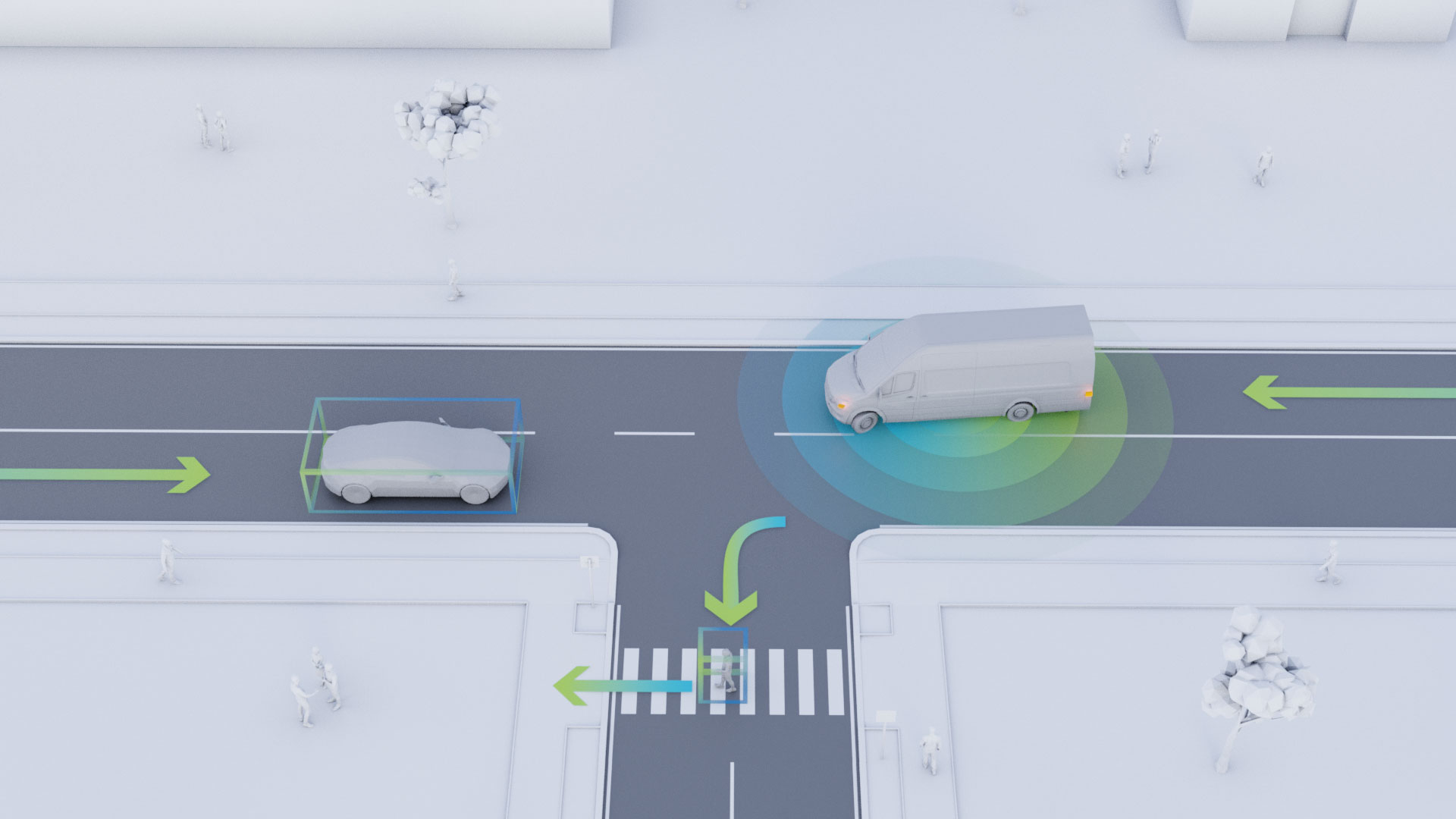
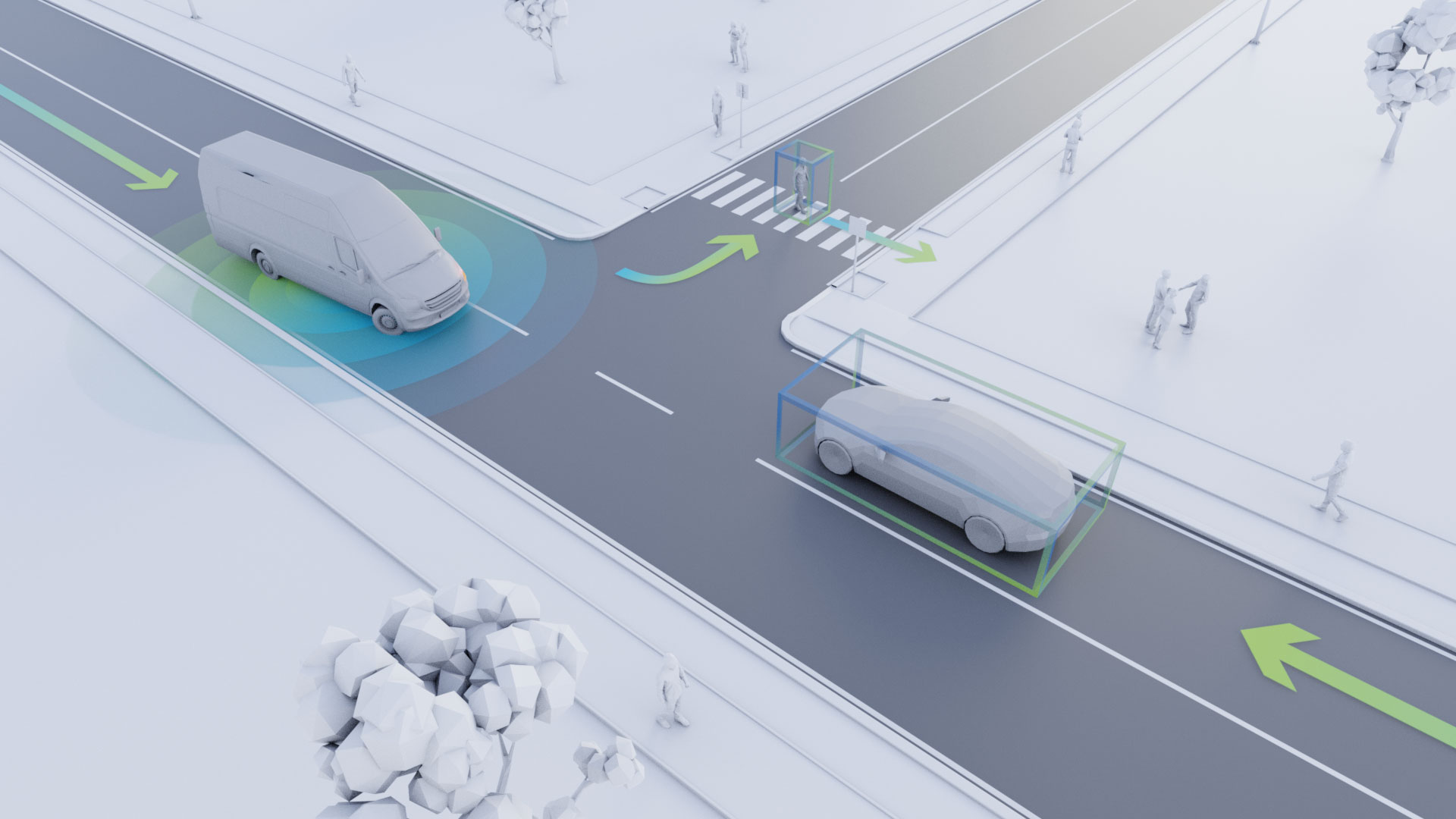
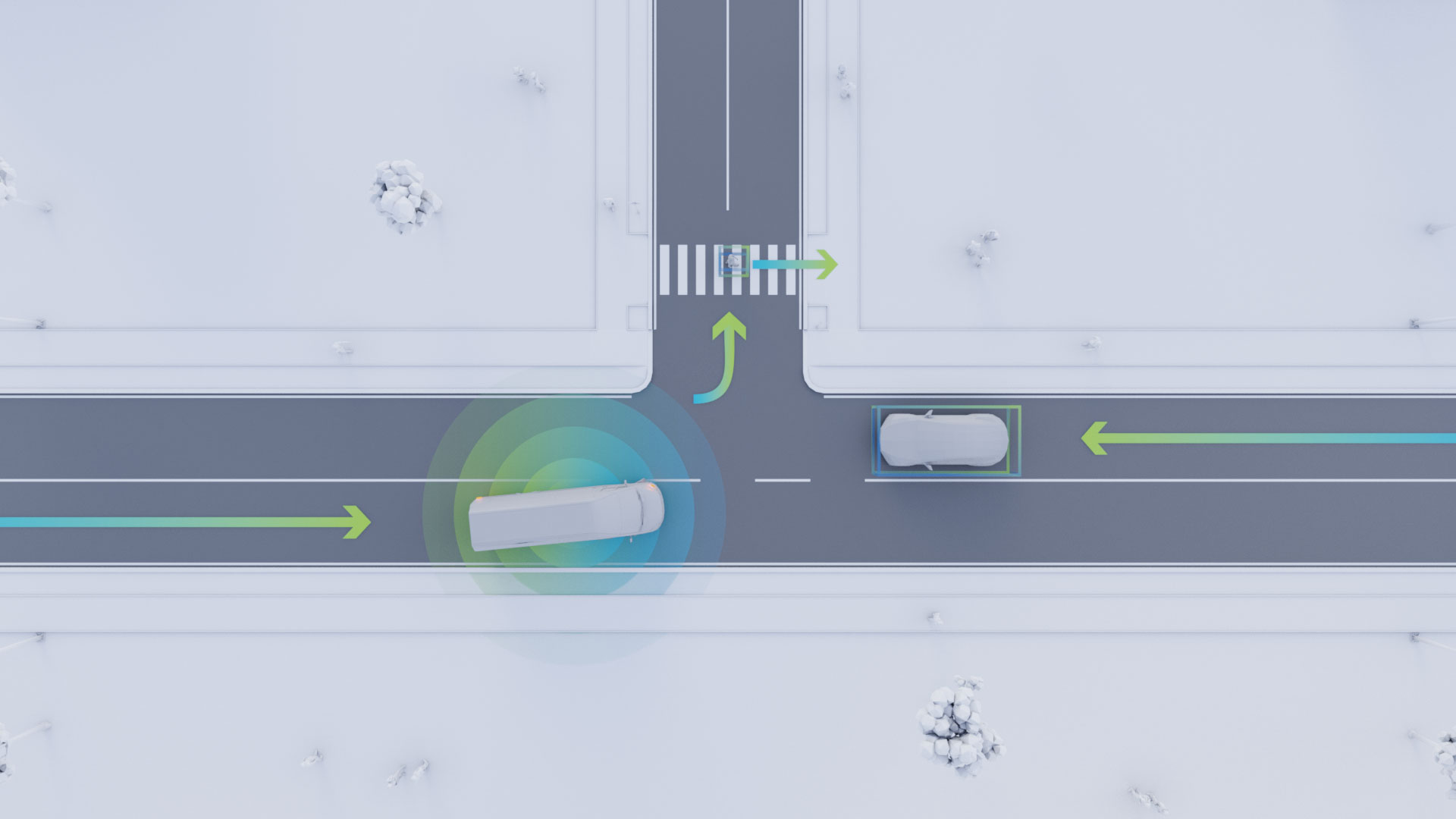
Use-Case 1 shows a traffic scenario on an uncontrolled intersection (90°). Vehicle 1 (car) drives straight ahead. Vehicle 2 (van) approaching and turning left is automated. A pedestrian (center of the picture) passes the crosswalk on the street into which the turning (transporter) is entering. The automated vehicle 2 (transporter) detects the oncoming vehicle 1 (car) and lets it pass and brakes to let the pedestrian cross.
Other planned use cases and test scenarios on the test track in St. Valentin:
- Turn scenarios
- Obstacle detection
- Crossing obstacles such as pedestrians, cyclists, motorcycles and much more, crossing scenarios in every form
- Two-way traffic scenarios
The crossings will be developed according to the guidelines of the research society “Straße – Schiene – Verkehr” (“Road – Rail – Traffic”) and the RVS (Richtlinien und Vorschriften für das Straßenwesen, guidelines and regulations for roads). With the traffic light system, C-ITS communications between vehicle and infrastructure can be tested on our test track in St. Valentin.
You might also be interested in
Further Insights

functional safety of automated driving functions – cooperation with msg Plaut
Digitrans and msg Plaut will cooperate in the field of automated safety and vehicle testing in the future and use the joint network for more extensive cooperations and projects.

Project RIAMO – rural communities enabled for integrated automated mobility
It involves the implementation of an efficient, automated on-demand shuttle service as part of a grant project. Accordingly, it is intended to provide residents of rural areas with better access to the higher-ranking public transport network.
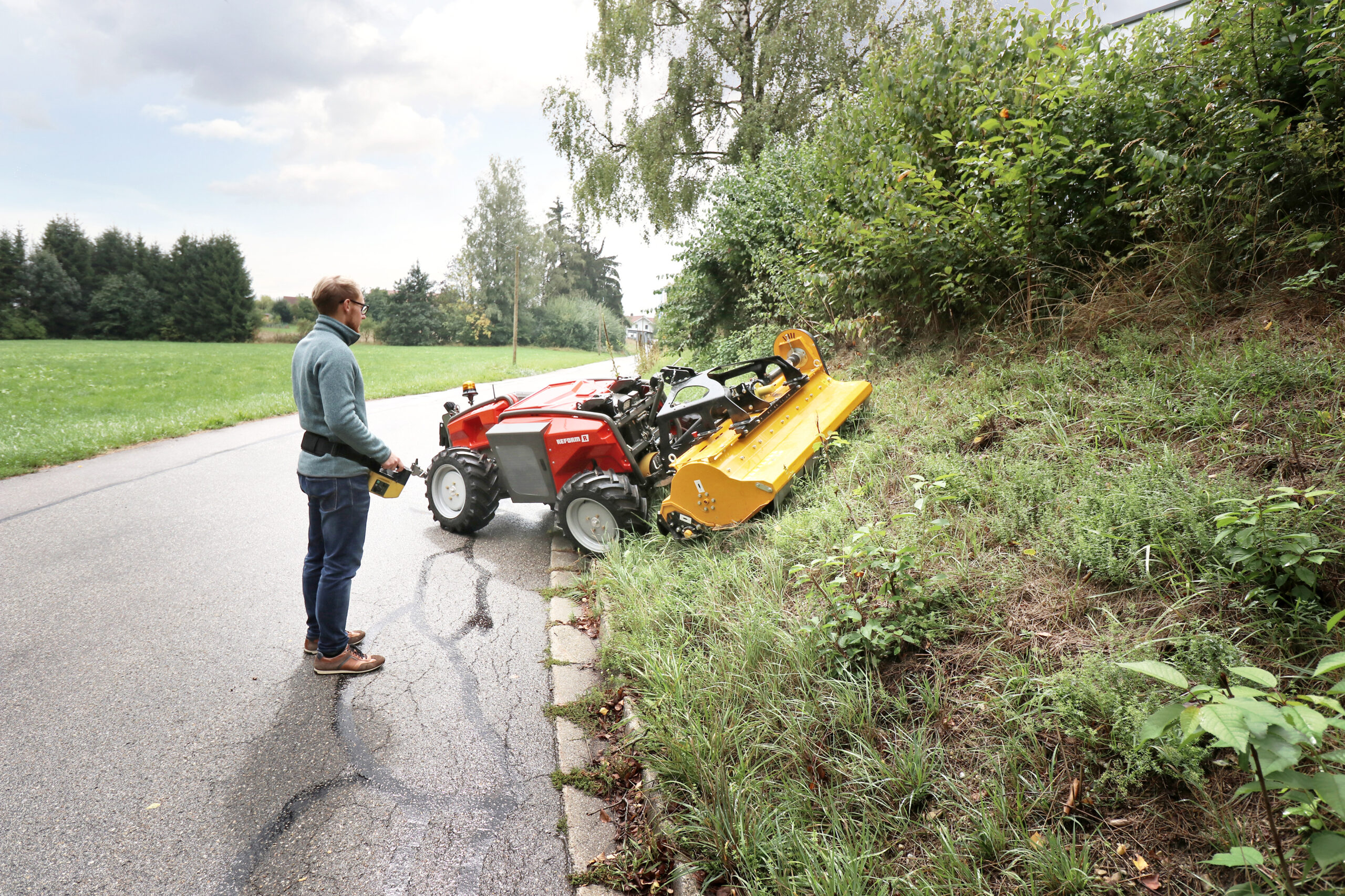
Clear track for testing automated commercial vehicles
Until now, the use of automated commercial vehicles for testing has been limited. One of the major hurdles up to now has been legislation. At the end of last year, DigiTrans GmbH worked together with Reform-Werke on a change in the law that is unique in Europe.